

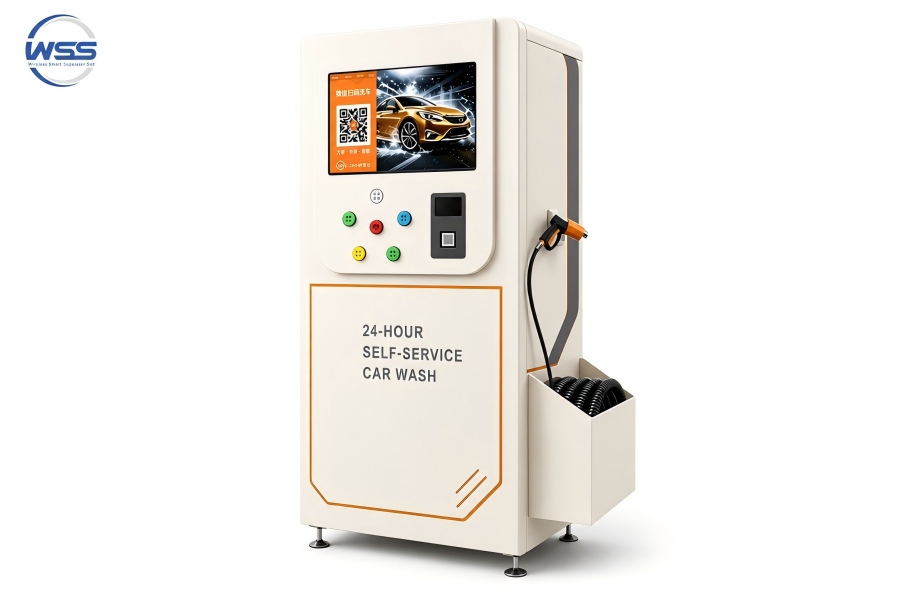
For gas stations and convenience stores, a self-service car wash can be more than an additional service. It can create another source of revenue without requiring a large increase in daily labor.
Sin embargo, choosing the right self-service car wash equipment is not simply a matter of comparing prices. Equipment reliability, payment options, mantenimiento, operating costs, and remote management all have an impact on the long-term performance of the business.
Entonces, what should operators look at before making a purchase?
Start with the Location and Expected Usage
The right equipment depends heavily on where it will be installed. A busy gas station may serve hundreds of vehicles every day, while a smaller convenience store may have a much lower customer volume. These two locations do not necessarily need the same configuration.
Before selecting commercial self-service car wash equipment, consider the available installation space, expected daily usage, water and electricity supply, drainage conditions, and vehicle access. It is also worth thinking about future demand. If the business is likely to expand, choosing equipment that can support additional functions or terminals may save time and investment later.

Look Beyond the Equipment Price
The cheapest commercial car wash equipment is not always the most economical option.
For a commercial operation, equipment may run many times a day. A pump or control component that frequently requires maintenance can quickly increase operating costs and cause unnecessary downtime.
Instead of looking only at the initial purchase price, businesses should consider the total cost of ownership, incluido:
- Equipment service life
- Pump and component quality
- Water and energy consumption
- Spare parts and maintenance
- Technical support
- Expected downtime
Reliable equipment can be a better investment when it helps keep the car wash running consistently.
Choose a Convenient Payment System
Payment is another important part of the customer experience. Customers at gas stations and convenience stores usually want a quick and straightforward process. They should be able to select a washing program, pay, and start using the equipment without assistance. Depending on the market, operators may need support for card payments, QR payments, cash, or other digital payment methods. A 4G smart payment system can also be useful for locations where stable network connectivity and remote transaction management are important. For operators managing several locations, centralized payment and operating data can make daily management much easier.

Consider Remote Management and IoT
Traditional car wash equipment generally focuses on the washing process itself. Hoy, businesses have another option: connecting equipment to cloud-based management systems.
With IoT-enabled self-service car wash equipment, operators can potentially monitor equipment status, transaction data, uso, and faults remotely.
This is particularly useful for gas station groups or businesses with multiple locations. Staff do not have to visit every site simply to check whether a machine is operating normally. Remote management can also help operators respond to equipment problems faster and make maintenance more efficient.
Pay Attention to the Pump and Core Components
For a self-service car wash, the pump is one of the components that deserves close attention. Stable water pressure and flow directly affect the washing experience. At the same time, pumps and other components need to withstand frequent commercial use. When comparing self-service car wash machines, ask suppliers about pump specifications, expected service life, replacement parts, and maintenance requirements.
It is also important to understand how easy it is to access and replace key components. Simple maintenance can make a significant difference when the equipment is operating every day.
Make the Customer Experience Simple
A self-service system should not require customers to spend several minutes figuring out how it works. Clear instructions, simple controls, convenient payment, and reliable equipment all contribute to a better experience. For gas stations and convenience stores, this matters because the car wash is often an additional service. Customers may decide whether to use it based on how convenient the process feels. A simple and reliable self-service car wash system is more likely to encourage repeat use.

Choose a Supplier That Can Support Long-Term Operation
The equipment is only one part of the investment. The supplier matters as well. Before purchasing, businesses should ask about technical support, spare parts, software updates, warranty policies, and customization options. This becomes even more important when the equipment includes both hardware and software.
WSS: Smart Equipment for Connected Retail
WSS is a provider of intelligent retail solutions and equipment, focusing on integrated solutions for the new retail industry. Its product portfolio includes vending machines, sistemas inteligentes de venta farmacéutica, Lavaderos de autos de autoservicio., y otros terminales minoristas inteligentes. By combining intelligent hardware, cloud-based systems, y tecnologías de IoT, WSS helps businesses improve operational efficiency and create more connected self-service experiences.
For gas stations, convenience stores, and other commercial locations, this approach makes it possible to manage equipment more efficiently while supporting the digital transformation of existing businesses.
Make the Decision Based on Long-Term Value
Choosing self-service car wash equipment for gas stations and convenience stores should ultimately come down to more than the purchase price. Businesses need equipment that can handle their expected workload, provide convenient payment, remain easy to maintain, and support efficient management. A reliable pump, smart payment system, IoT connectivity, and remote management capabilities can all contribute to better long-term performance. For businesses planning to add or upgrade a self-service car wash, evaluating these factors before purchasing can help reduce operating risks and build a more sustainable service.