

Choosing the right smart vending fridge manufacturer can directly affect your product quality, development costs, and time to market. For importers, distributors, and unattended retail operators, understanding the difference between OEM and ODM manufacturing is essential to making the right investment.
Both models offer advantages, but the best choice depends on your customization needs, budget, and business goals. Dans ce guide, we will compare OEM and ODM smart vending fridge manufacturing and explain how to choose the right partner for your business.

1. What Is an OEM Smart Vending Fridge Manufacturer?
OEM (Original Equipment Manufacturer) manufacturing allows buyers to develop products based on their specifications and agreed requirements.
For smart vending fridges, customization may include cabinet design, branding, internal layout, hardware configuration, and software integration, depending on the manufacturer’s capabilities.
Key advantages of OEM:
- Greater control over product specifications.
- More opportunities for product differentiation.
- Flexibility to address specific market requirements.
- Better alignment with established brand strategies.
Idéal pour: Established brands, importers, and distributors that need customized products or specific technical configurations.
Cependant, extensive customization may increase development costs and extend production timelines. Buyers should clarify engineering fees, minimum order quantities, and intellectual property ownership before starting a project.
2. What Is an ODM Smart Vending Fridge Manufacturer?
ODM (Original Design Manufacturer) manufacturing allows buyers to select an existing product design developed by the manufacturer and customize it within an agreed scope.
Instead of developing a product from scratch, businesses can start with an available smart vending fridge and focus on branding, distribution, and retail operations.
Key advantages of ODM:
- Potentially lower initial development costs.
- Shorter development timelines when modifications are limited.
- Easier product selection and evaluation.
- Convenient branding options, depending on the supplier.
Idéal pour: Startups, vending operators, and distributors looking to enter the unattended retail market without extensive product development.
The main limitation is that customization may be restricted by the existing design. Always confirm which features and modifications are available before placing an order.

3. OEM vs. ODM: Key Differences
| Factor | OEM | ODM |
|---|---|---|
| Product design | Based on buyer specifications or an agreed custom design | Based on an existing manufacturer design |
| Personnalisation | Potentially extensive | Usually more limited |
| Development cost | May be higher | May be lower |
| Time to market | Depends on project complexity | Potentially shorter |
| Product differentiation | Greater flexibility | Often relies on existing designs and branding |
| Ideal customers | Established brands and specialized projects | Startups and businesses seeking existing solutions |
These differences are general guidelines. Actual costs, lead times, and customization options depend on the manufacturer’s capabilities and project requirements.
4. How to Choose the Right Manufacturing Model
The right option depends on your business priorities.
Choose OEM if you need:
- Customized product specifications.
- Distinctive branding and product design.
- Specific hardware or software integration.
- Greater control over agreed product requirements.
Choose ODM if you want:
- A practical starting point for a new business.
- Lower upfront product development requirements.
- An existing product that meets your needs.
- A simpler path to market.
For importers and distributors, comparing both options can be particularly useful. If an existing model meets your customers’ besoins, ODM may be sufficient. If your market requires features that standard products cannot provide, OEM may offer greater value.

5. What to Look for in a Smart Vending Fridge Manufacturer
Beyond the OEM or ODM model, evaluate the manufacturer’s technical capabilities and long-term support.
Refrigeration Performance
Check the supported temperature range, temperature stability, cooling performance, and suitability for your intended products.
AI Scan-to-Open Technology
Confirm how users unlock the fridge and how products are identified and paid for. Scan-to-open access does not automatically include AI product recognition or automated payment processing.
Payment and Software Integration
Verify compatibility with your preferred payment methods and vending management platform. Clarify whether additional hardware, logiciel, or recurring fees are required.
Quality Control and After-Sales Support
Review production testing, warranty coverage, spare parts availability, technical documentation, and maintenance support.
A reliable manufacturing partner should provide clear specifications and realistic information about product capabilities.
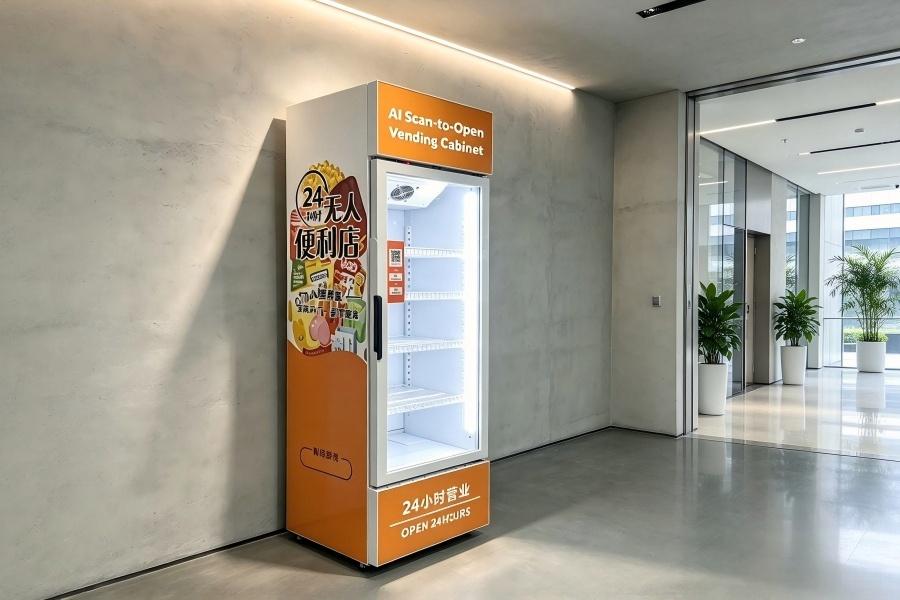
6. Choosing a 330L Smart Vending Fridge for Your Business
A 330L AI scan-to-open self-service vending fridge may suit offices, hôtels, residential communities, and other unattended retail locations.
Cependant, nominal capacity alone does not determine whether a model is right for your business. Consider:
- Product mix: Can the shelves accommodate your intended beverages, collations, or packaged meals?
- Usable space: Does the internal layout support efficient product storage?
- Replenishment: How frequently will inventory need to be restocked?
- Installation: Are the cabinet dimensions, ventilation, and power requirements suitable?
If an existing 330L model meets your operational needs, an ODM solution may be practical. If you require specific design or technical modifications, discuss the feasibility of OEM customization.
7. How WSS Can Fit into Your Sourcing Process
When evaluating WSS as a potential smart vending fridge manufacturing partner, start by defining your target market, required functions, and customization priorities.
A structured evaluation should cover three areas:
- Product requirements: Confirm capacity, refrigeration specifications, access control, payment compatibility, and management functions.
- Customization options: Determine which branding, hardware, or software modifications are available.
- Commercial terms: Clarify pricing, minimum order quantities, production lead times, warranty coverage, and technical support.
This process helps you determine whether an existing product or a more customized manufacturing arrangement is appropriate for your business.
Pour les acheteurs B2B, the goal is not simply to find the lowest price. It is to select equipment that meets market requirements while supporting long-term operating efficiency.
Conclusion: OEM or ODM Smart Vending Fridge Manufacturer?
OEM and ODM manufacturing serve different business needs.
OEM is generally better for businesses that require greater product customization and differentiation. ODM is often more suitable when an existing design meets requirements and reducing development work is a priority.
Before making a decision, compare product specifications, total costs, customization capabilities, and after-sales support.
WSS can be included in your supplier evaluation as you explore smart vending fridge solutions for your target market. Define your requirements first, then discuss available configurations and customization options to identify the most suitable approach.
Looking for a smart vending fridge solution for your business? Contact WSS to discuss your product requirements and potential manufacturing options.

Foire aux questions
What is the main difference between OEM and ODM smart vending fridges?
OEM generally involves manufacturing based on buyer specifications or an agreed custom design. ODM typically uses an existing manufacturer design that can be branded and modified within an agreed scope.
Is OEM more expensive than ODM?
OEM may involve higher development costs when custom engineering or tooling is required. ODM may reduce upfront costs by using an existing product platform.
Can I sell an ODM smart vending fridge under my own brand?
Often, yes. Private labeling and selected customization options depend on the manufacturer’s policies and the terms of the agreement.
What should I check before buying a 330L AI scan-to-open vending fridge?
Review capacity, refrigeration performance, access control, payment compatibility, software functions, warranty terms, and applicable compliance requirements.